You'll walk the whole hiring path here — before you walk it for real.
A real process isn't one interview: your CV gets screened, a recruiter calls, then the real interviews begin. Interview Coach rebuilds that exact path for every position you're chasing, so nothing you meet out there is a surprise. Here's the walk, step by step.
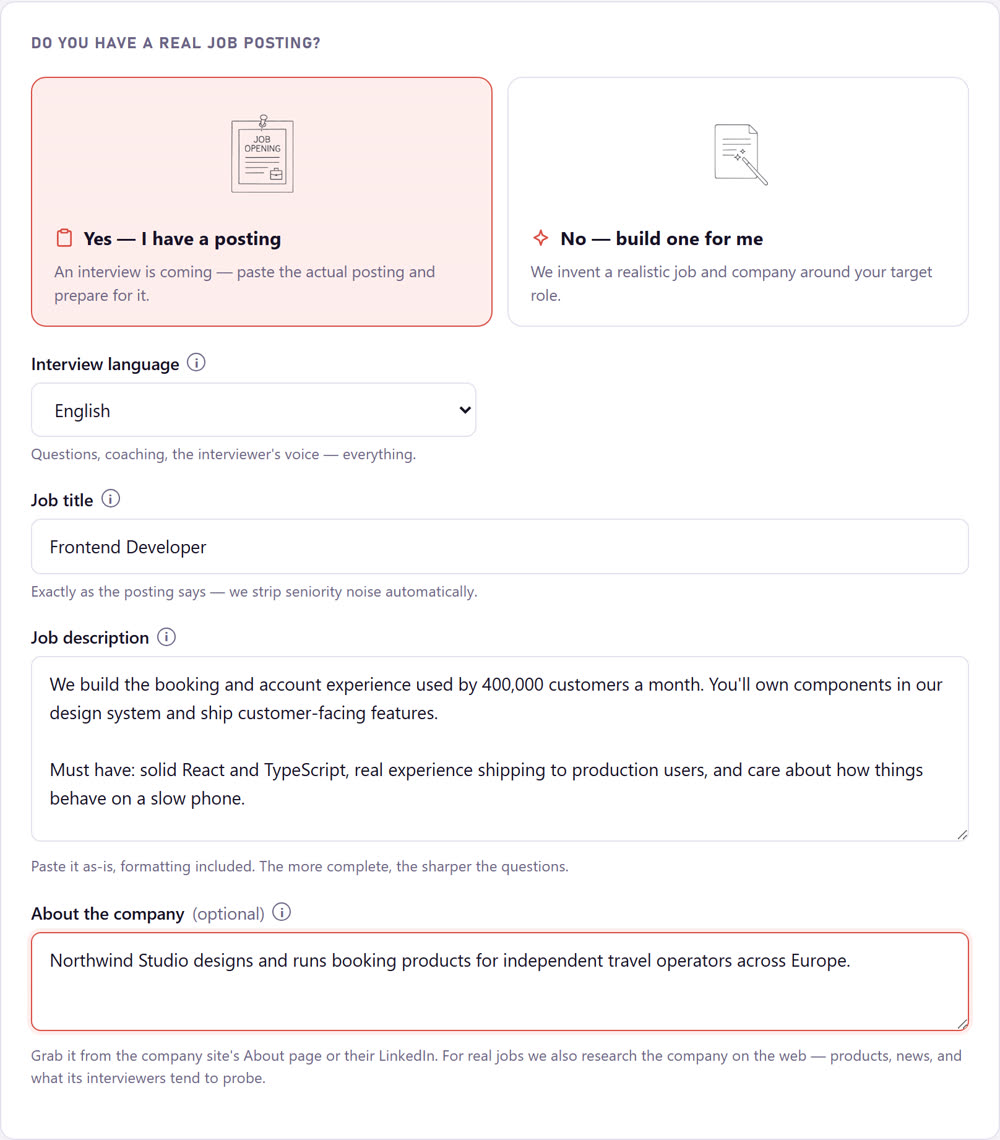
Tell us about the job — we do the homework
Paste the job posting and the company's about-us, and attach your CV. From that we map the role to real occupational data, read your CV like a recruiter, score your fit — and research the company live on the web: products, market, news, and what their interviewers tend to probe.
No posting yet? Choose "No — build one for me" and we invent a realistic company and posting for your target role. No CV yet? Build one here — or a junior profile, if your evidence is coursework, a project and a shift job rather than a career.
The interview runs in any of 11 languages, chosen per position and spoken natively — not translated.
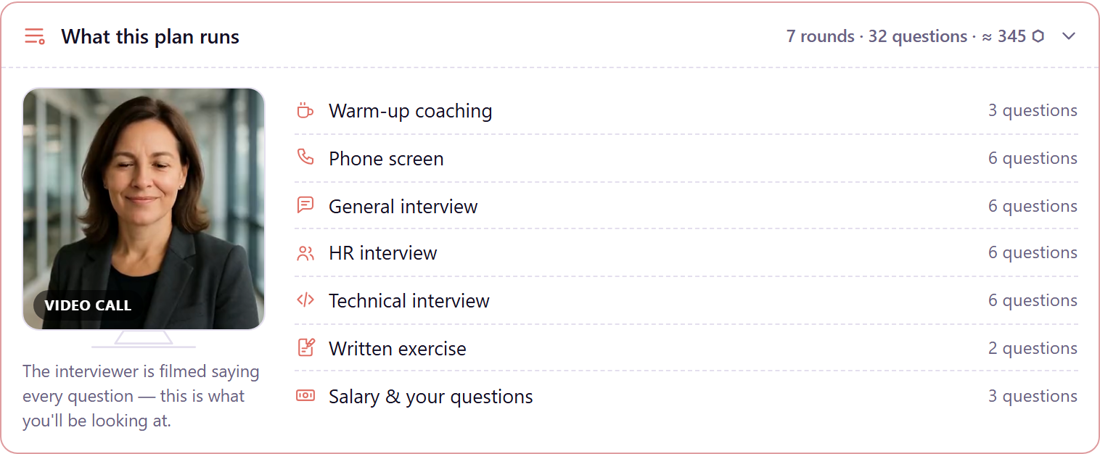
Choose how deep to go — nothing is sold to you
There are no tiers here, only recommended ways to spend your tokens. Full interview runs every round at full depth — 7 rounds, 32 questions. Shorter keeps the same shape with about half the questions. Minimal is a four-round arc. Custom lets you pick the rounds, set each one's question count, and write questions yourself. And Junior training gives every question the coaching to answer it, fading the help round by round as you get good.
Whether the interviewer is on camera is a separate choice, not a tier — the same questions either way. Video is the closest thing to the real screen; voice over a portrait costs a fraction. Before you commit, the panel spells out which rounds will run, how many questions each asks, and what it will cost.
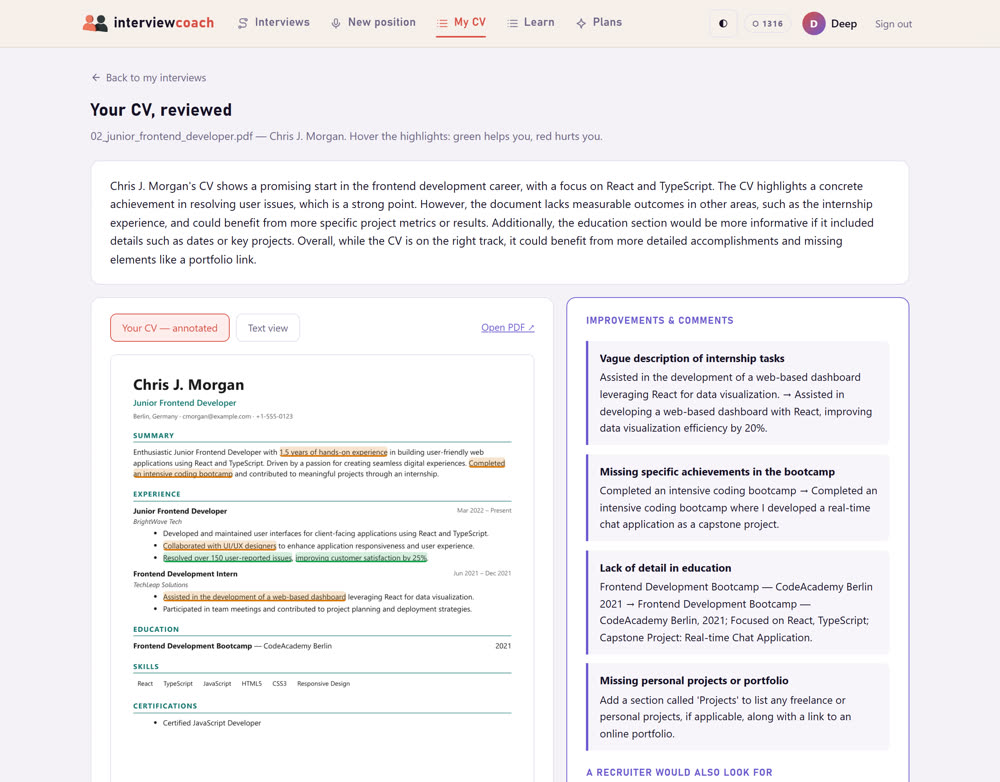
Your CV gets interviewed first
Before anyone calls, the coach reads your actual CV — the real document, not a text dump — and pins comments right on it: green for what works for you, red for what works against you, with a fix for each. Employment gaps, vague claims, buried wins — flagged before a recruiter finds them.
You also get an application kit per position: a cover letter, an intro message, and your CV re-tailored to that exact role — edit anything yourself, or mark a passage and tell the coach what to change.
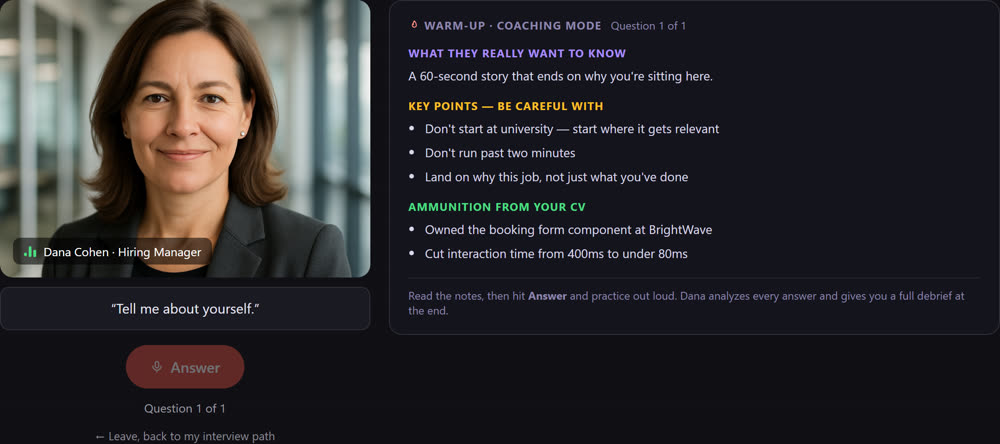
Warm up on the questions that decide everything
Three essential questions — starting with the one that matters most: "tell me about yourself." Beside the interviewer you get live coaching notes: what they really want to know, the traps to avoid, and talking points pulled from your own CV.
Answer out loud, as many rounds as you need, until your story comes out clean every time.
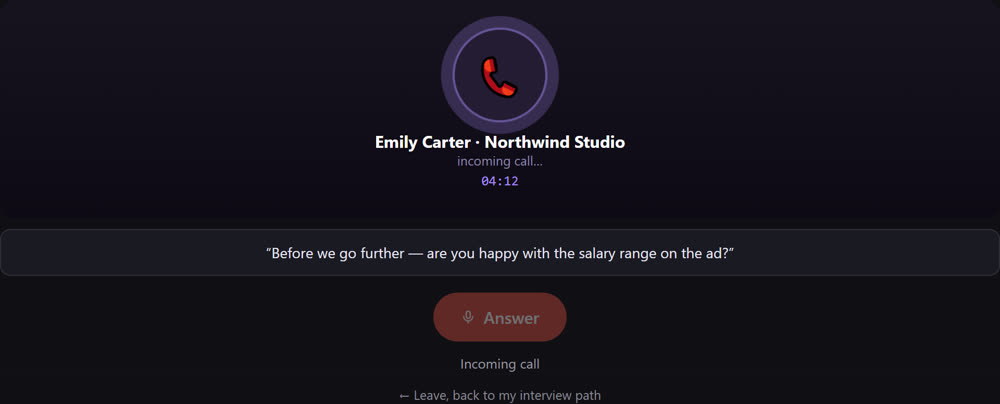
The recruiter calls
It starts like the real thing: the phone rings, you pick up, and Emily from the company's recruiting team asks if it's a comfortable time. Then the classic 15-minute screen — quick background, why this company, do you actually meet the must-haves, salary and logistics.
Short questions, short answers — exactly the call that decides whether you move forward.
Face the interviewer — out loud
You face a panel, not one person — the way real hiring works. Dana, the hiring manager, runs the general interview; Maya, an HR business partner, takes conflict, values and the gaps in your history; Alex, a staff engineer, runs the technical round and pushes on the trade-offs you skipped. They have read your CV, your LinkedIn if you shared it, and the company research — and it shows: they quote your own history back at you and ask follow-ups built from what you just said.
The technical round ends with a written exercise — a realistic task for your exact profession, reviewed live with follow-up questions on your solution.
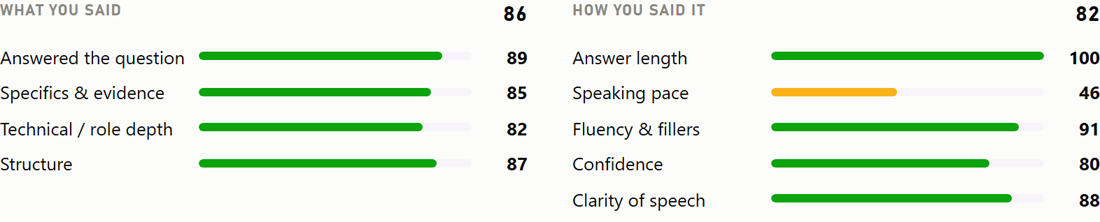
The debrief — honest, specific, useful
Every answer is scored in nine categories, not one number. What you said: did you answer the question, were there specifics, was there depth, did it hold a structure. How you said it: answer length — too short, too long or well judged — pace, fluency and fillers, confidence, and clarity. You see which one is dragging you down, which is the only kind of score that tells you what to do next.
The headline is arithmetic over those categories, never a second opinion, so the number and the write-up cannot contradict each other. And it is scored strictly on what you actually said: a strong CV earns nothing for an answer you did not give, and a question you stayed silent on scores zero for silence rather than being quietly rated anyway.
Every answer is annotated like your CV was: hover the highlights to see what worked and what hurt — next to a stronger answer written from your own experience, so you can actually give it next time.
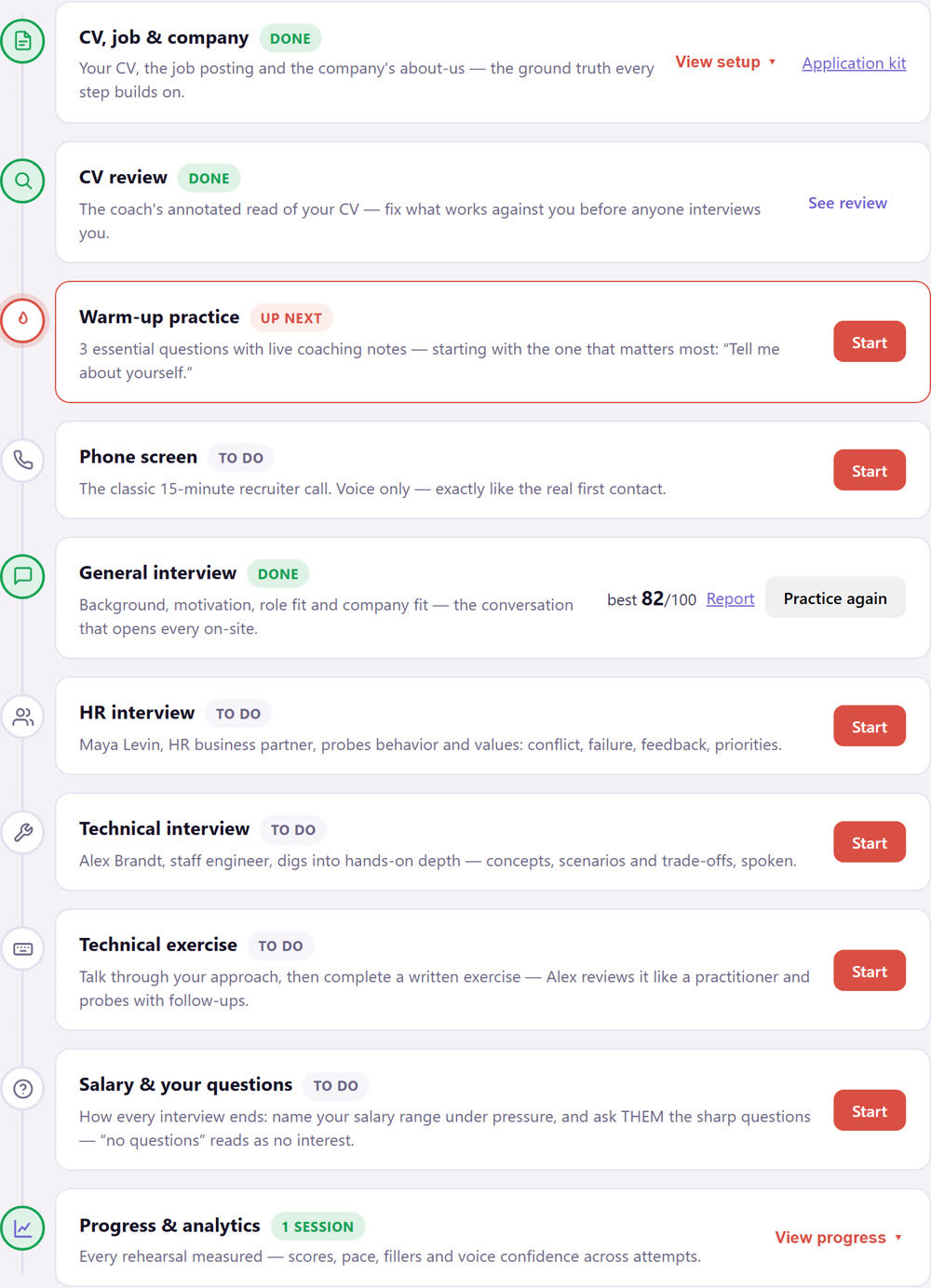
One journey per company — run several at once
Interviewing at three places? Each position keeps its own path: its own CV version, company intel, practice steps, contacts — save the recruiter's email when you get it — and a schedule for your real interviews, so you can practice the matching step the night before each one.
Scores track across attempts, so you can watch yourself getting better — and once you have a few answers on a position it will tell you what you are worst at. Not a guess: the categories you actually lose marks on, measured across every answer you gave here, with the option to generate questions that go straight at them. Reading the diagnosis is free; you only spend tokens if you want the drill.
Pay for what you use — nothing else
No subscriptions. You buy tokens once, they stay valid for a full year, and each interview consumes what it actually uses. Start free with a phone interview and a repeat, then pick the depth — and whether the interviewer is filmed, which is what really moves the cost:
A filmed question costs about 9 tokens, an answered one about 1 — so voice-only practice runs at roughly a seventh of the price and asks exactly the same questions. Tokens are bought by the dollar — $5, $10, $15 or $20, always at 25 tokens per $1 — and a batch of five extra questions is 5 ⬡.
The next real interview doesn't have to be your first take.
Set up your first position in about two minutes — and before the real day, read the Interview Day Manual.
Start practicing free